At the Lycée Technique Agricole in Gilsdorf, students train for agricultural professions shaped by working with soil, plants, and water. Watering is part of daily practice—a word that in German shares its root with casting: gießen means both watering plants and casting metal. In the 19th century, bronze was cast not far from the school, into bells and into tools for agriculture. This double meaning of gießen—as care and as forming—runs through the project from the outset. Bells and their ringing techniques are cultural techniques and means of communication—they structure time, mark space, and connect people on an acoustic level. At the same time, they are instrument, sculpture, and image-bearing object. Their production follows an alternation between positive and negative: clay is shaped, form becomes bronze, bronze becomes sound. For the realization of the carillon, the artist collaborated with the Grassmayr bell foundry in Innsbruck, which has existed since 1599.
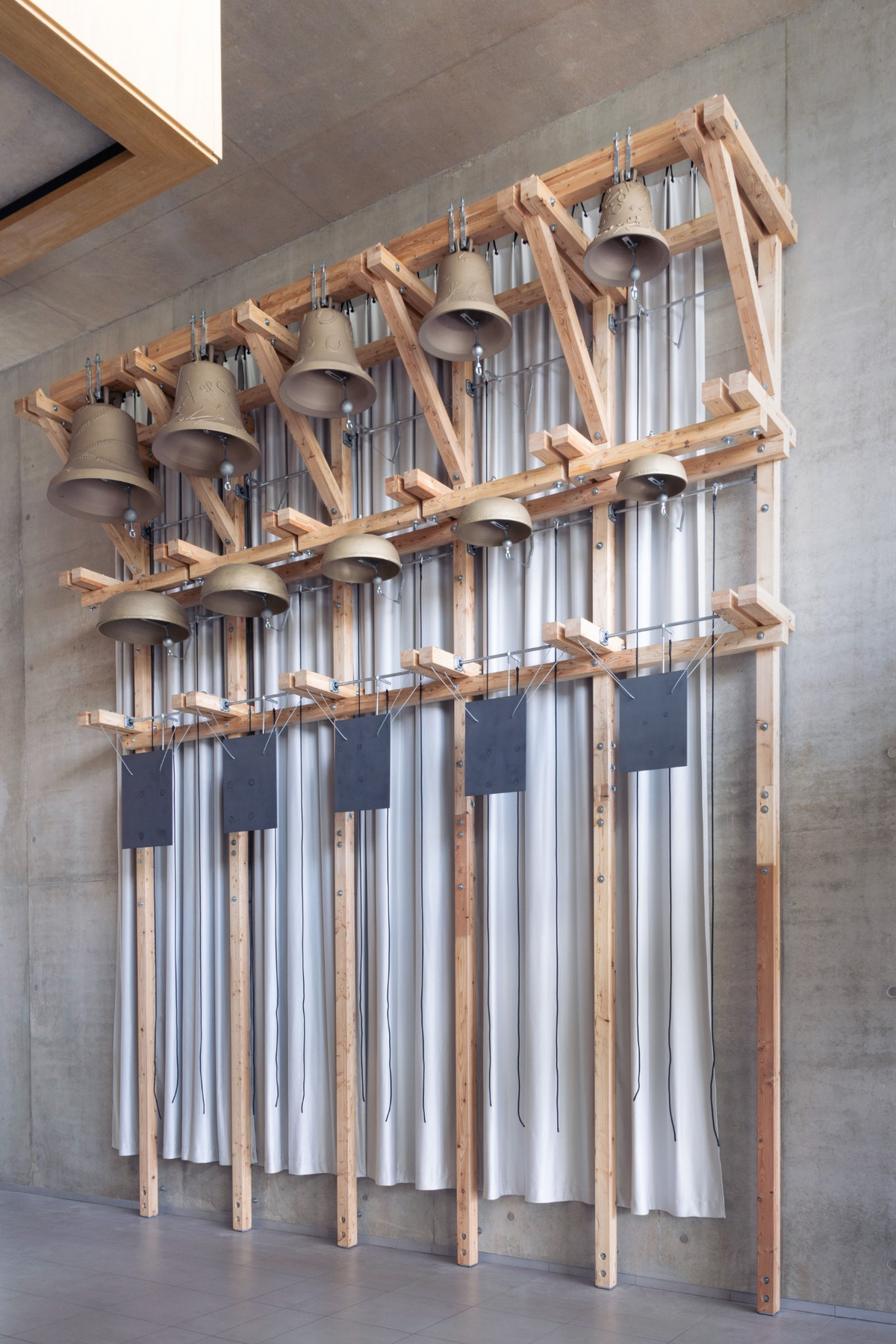
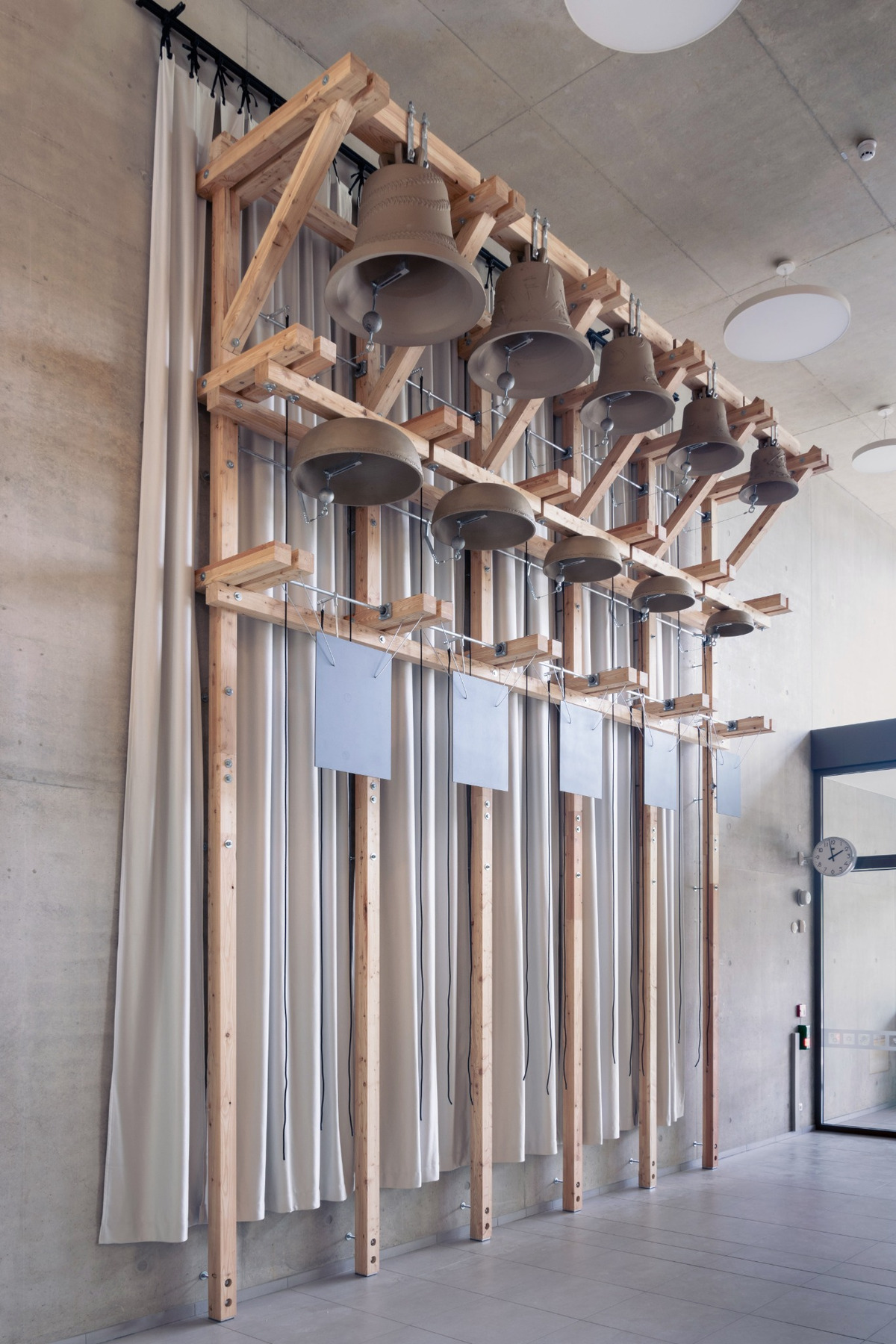
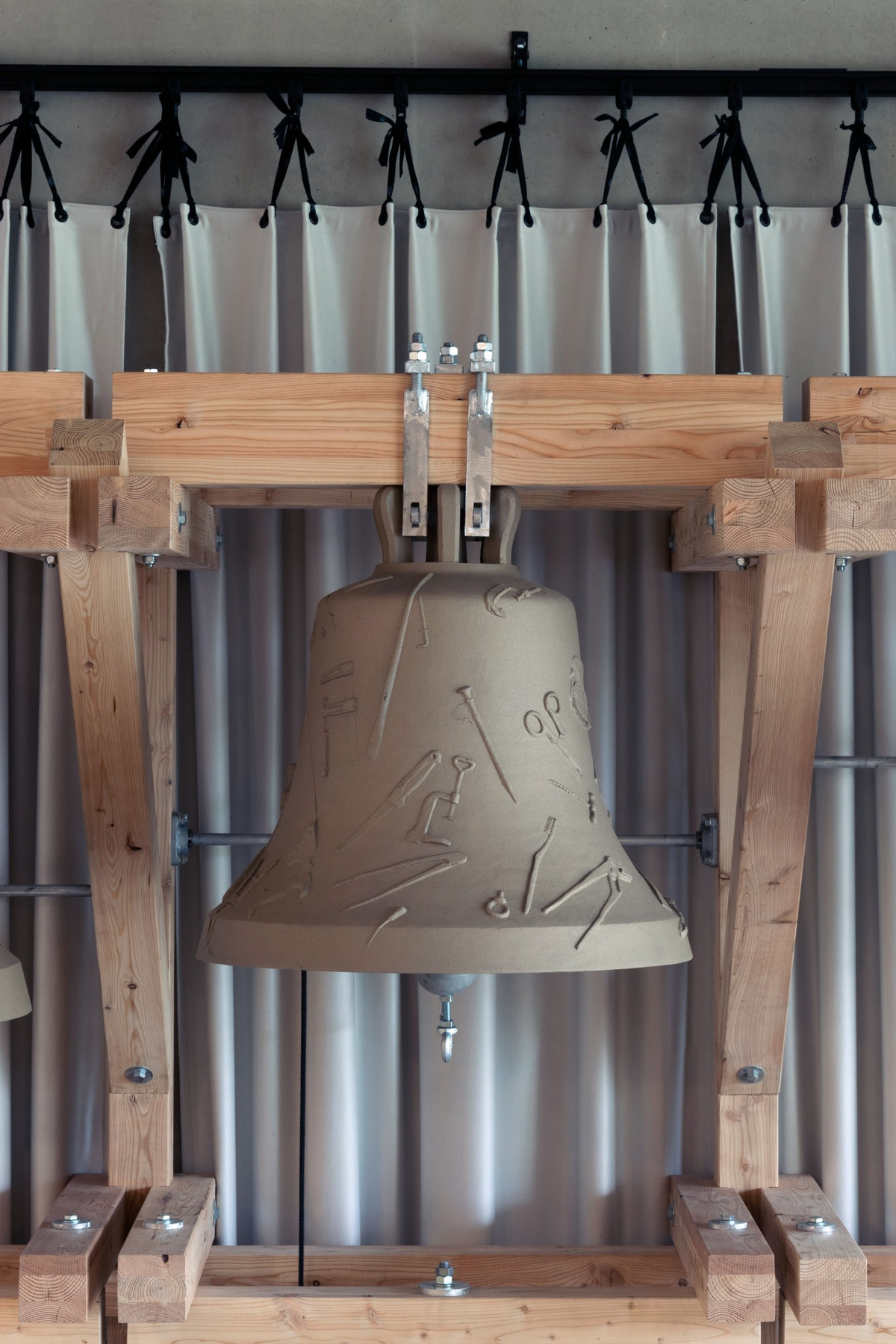
Students and teaching staff of the school have inscribed themselves into the surfaces of Gils Bells. In workshops, clay models were created with impressions and motifs from their environment: tractor tracks, tools, horseshoes, screws, chainsaw chains, and thumbtacks. These traces became part of the casting moulds and now appear as reliefs and impressions on the instruments. The carillon thus bears the handwriting of those who surround it—it becomes a carrier of collective identity, an object of identification for the school community. The carillon consists of five bells tuned to the extended Gloria motif c–d–f–g–a#, complemented by five percussion bowls and five steel sound plates that continue the same tonal structure in lower octaves. The sequence allows for the simplest melodies such as Happy Birthday, but also for free improvisation. Several people are needed to play the installation in its entirety. Its sound emerges through communication and coordination, thus forming a social space.
In the foyer, the carillon develops vertically along a wooden construction, a curtain behind it delimits the installation from its surroundings and concentrates the sound. The entrance hall thus becomes an acoustic resonance chamber, and what normally sounds through school buildings as an automatic time signal becomes a manually played instrument here. The bells shift from a signal from above to a moment of participation. In communal playing, a resonance body also emerges within the school community, one that materializes in sound. GILS BELLS thus operates according to a principle of the school itself: knowledge grows through exchange, through collective action, through the communication of different perspectives. The carillon translates this principle into a spatial and sonic situation. Architecture, materiality, and community form a system that invites new ways of playing and permits new exchange of knowledge between those who learn and teach here.